



Caravel
Called “caravela” in Portuguese, the caravel is one of the most amazing ships in naval history. It was used by the Portuguese from the 15th through the 18th centuries! However, it did go through many modifications along the way, some of them significant.
The early caravels were around 20×6 meters and had a displacement (mass) of 50 tons. Their design was based on earlier Middle Eastern ships. They used two or three masts with lateen sails which allowed them to sail against the wind. Caravels had the advantage of being small and agile, often used for advanced transport and exploration before sending in larger cargo ships like the carrack and galleon.
This versatile ship helped make Portugal one of the world’s great naval powers in the fifteenth century.
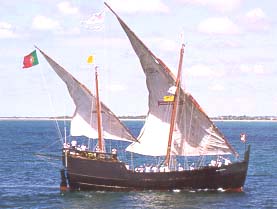
(Image: Brazilian Navy)
Later versions combined three lateen-sail masts with a foremast of two “round sails” (actually square sails which billowed out roundly in the wind). The dimensions increased to around 30 meters long and a displacement of 150 tons. This new design became known as the “caravela redonda” (round caravel). The square sails increased speed, while the augmented size allowed the addition of cannons, so the ships could be used for combat as well as transport and exploration.
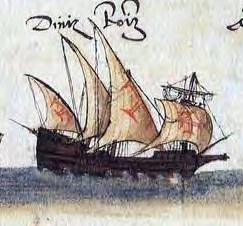
(Image: Livro de Lisuarte de Abreu – 16th century)
In “The Fortuitous Meeting”, Gerard speaks of his trip from Europe to Brazil in a Caravel.


