

Posts Tagged food

Pineapple

In “The Fortuitous Meeting of Gerard van Oost and Oludara”, Gerard mentions that the pineapple is “regarded as one of the sweetest flavors in the world.  It is so treasured by the Portuguese, they ship trees all the way to India to make sure the fruit is never far from their colonies.”
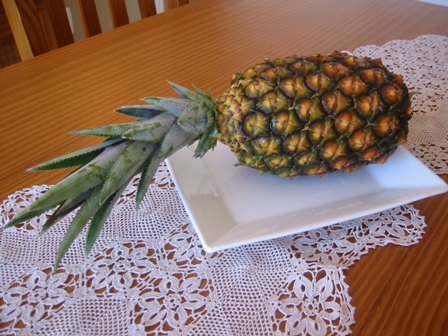
Pineapple1

The pineapple was indeed held in high esteem in the sixteenth century.  The men who wrote the earliest descriptions and histories of Brazil were unanimous in their praise of the fruit.  Here are a few of their comments:

  • “The fruit is very fragrant, tasty, one of the best in the world, full of juice and flavor.” – Fernão Cardim
  • “The flavor is very sweet and so suave that no Spanish fruit is its equal in form, flavor and smell.” – Gabriel Soares de Sousa
  • “They are so flavorful that, in the opinion of all, there is no fruit in this realm that bests their taste.” – Pero de Magalhães de Gândavo
  • “A fruit that in form, smell, and flavor exceeds all others in the world.” – Frei Salvador

Shortly after the Portuguese and Spanish discovered the fruit, they began shipping it to other tropical colonies for cultivation.

Today, the pineapple is referred to as “ananás” in Portugal, but as “abacaxi” in Brazil.  I believe this is because the Spanish learned the word “naná” from their contact with the Guarani, which they soon transmitted throughout the Iberian Peninsula.  But the Brazilians continued to use the Tupi version “ibá” (fragrant) + “cati” (fruit).  I’ll be discussing the different Tupi peoples and their language much more in the future.

So on that note, I think it’s time for me to have a snack!  Bet you can’t guess what…
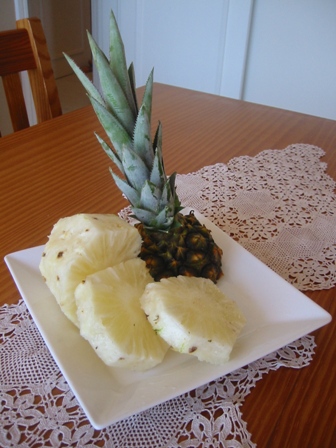
Pineapple2

(Photographs by Christopher Kastensmidt)


Meal in Salvador, Oludara’s

What better way to celebrate the launch of this website than with a tasty meal?

In an early scene of “The Fortuitous Meeting of Gerard van Oost and Oludara”, Gerard offers a meal to Oludara in exchange for a tale.  This meal includes grouper, beans and rice, roasted manioc, corn bread, and pineapple.  Oludara refers to it as a “feast”.

In the future, I’ll be going into more detail on some of these foods and their importance in Colonial Brazil, but for today’s post, I thought I might recreate this meal, and see how much of a feast it really is.  I ended up having to do a couple of substitutions, but it comes close.

Let’s start with something easy, the corn bread:

Meal_01

Although corn wasn’t the primary staple among the Brazilian natives that it was in other parts of America (losing that distinction to manioc), it was used to create alcohol, medicine, and popcorn, among other things.  The Portuguese frequently used it to make bread and cakes.

Next we slice up a pineapple:

Meal_02

Small and sweet, the pineapple in this picture was grown in my state (Rio Grande do Sul), about ninety minutes from where I live.  In fact, the southern region of Brazil gave origin to the fruit.  Pineapple appears in a lot of colonial literature, and I’ll be giving the fruit its own write up in the future.

Even though manioc is common in dozens of dishes in Brazil, the local stores just happened to be out of the raw tuber, so I substituted a different starchy root in its place: arracacha (known as “mandioquinha” in Brazil).  If you’re ever in Brazil, I highly recommend trying the puree, which is rich and delicious:

Meal_03

I won’t write anything else about arracacha, which wasn’t present in Brazil in the sixteenth century (it is native to the Andes), but I will go into much more detail about manioc in a future post.  Manioc was the staple food in Brazil when the Europeans arrived, and continues to be one of the most-eaten carbohydrates in the world.

Next we have rice and beans:

Meal_04

Rice was introduced very early on during the Portuguese colonization of Brazil.  And when you use the word “feijão” (bean) in Brazil, by default you’re referring to the black bean shown here.  The combination of rice and beans became a staple even in the earliest colonies, and it remains so today.  Many Brazilians eat beans and rice every day.

And last but not least, we have our fish:

Meal_05

Oludara ate grouper, but I had to substitute a different white fish for my dinner: St. Peter’s fish.  The end result looks a lot the same.  I prepared this with fresh cilantro and some pepper.

So when we’re all done, the final plate looks like this:

Meal_06

Conclusion: Oludara’s meal in Salvador really was a feast!

All the food that Oludara ate over four hundred years ago is still eaten frequently in the restaurants and homes of Brazil today.

And if you don’t mind, that’s exactly what I’m going to do — eat it!  This meal looks fantastic!

Meal_07

(Photographs by Christopher Kastensmidt)