
Posts Tagged historical figures

Caramuru

In “The Fortuitous Meeting of Gerard van Oost and Oludara”, Gerard hears mention of Caramuru.  Even in the late sixteenth century of Gerard’s adventures, Caramuru was already a legend.  His extraordinary life would change Brazil’s history forever.

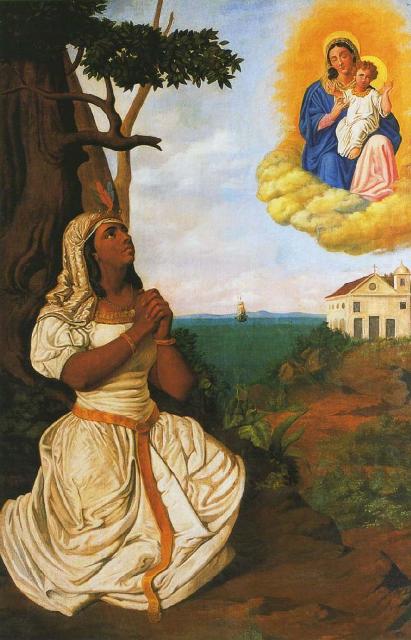
Born Diogo Álvares Correia, Caramuru was a Portuguese who shipwrecked in Brazil around 1510, at the age of 17.  Despite his inauspicious shipwreck, he had the fortune to swim ashore just ten kilometers from the Bay of All Saints, one of the greatest natural ports in the Western Hemisphere.  He also had the luck to shortly thereafter meet Paraguaçu: daughter of Morubixaba Taparica, a great Tupinambá warrior-chief in the region.

Caramuru arrives in Brazil (by Ernesto Frederico Scheffel)

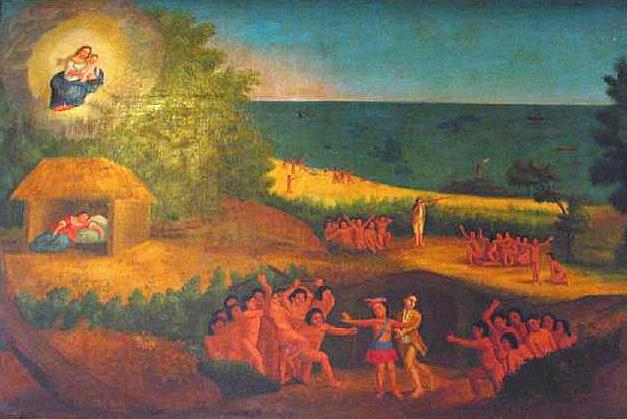
It is told that Caramuru first impressed the natives by shooting down a flying bird with one explosive shot from a harquebus.  But what truly saved him was the love of Paraguaçu.  They soon became husband and wife, and with a few other shipwreck survivors and many Tupinambá, he settled his own tribe in what would later become the city of Salvador.  The Tupinambá gave him the name Caramuru, which probably came from the Tupi word for the moray eel, in reference to his long, “stinging’ harquebus.  There are some, however, who claim it is a distortion of “caraymuru”, which means “wet white man”, since he washed out from the sea.

Caramuru sculpture

For years, Caramuru worked with the French and others who visited Brazil looking for Brazilwood and other plunder.  The French came to know the area where Caramuru lived as “Pointe du Caramourou”.  There are tales of him saving shipwrecked Portuguese, French and Spanish sailors, and rescuing them from other Tupinambá tribes which would have killed or in some cases even eaten them.  Charles V, Holy Roman Emporer, once sent Caramuru a letter of thanks for his aid.  Some shipwreck survivors and deserters remained with Caramuru, marrying his daughters or other natives.

In 1526, Caramuru and Paraguaçu travelled to France.  In 1528 Paraguaçu was baptized and given the name Katherine du Brézil in honor of her godmother, Catherine des Granches (wife of the famous french explorer Jacques Cartier).  Upon their return to Brazil, Caramuru and Paraguaçu became the first Christian couple in Brazil on record.  As far as is known, no other Christian women were living in brazil at the time, and very few would move there even to the end of the century.

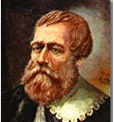
Caramuru portrait

The Portuguese soon became interested in taking advantage of Caramuru’s excellent relations with the natives for their colonization attempts.  in 1536, Francisco Pereira Coutinho arrived in Brazil to found the Captaincy of Bahia.  He allied himself with Caramuru and officially granted him his tribe’s land: right in the heart of modern Salvador.

When the time came to set up the General Government of Brazil, John III, the king of Portugal, decided to locate the capital in Salvador: in large part to Caramaru’s presence there and his prestige with the local natives.  Several other settlements had failed because of fights with the natives, and the Portuguese needed somewhere stable to make their base.  John III sent a letter to Caramuru in 1548 asking for his aid in establishing the new government, which Caramuru provided on the arrival of Tomé de Souza a year later.

Caramuru died in 1557, and Paraguaçu in 1582.

Statue of Caramuru and Paraguaçu in Viana do Castelo, Portugal

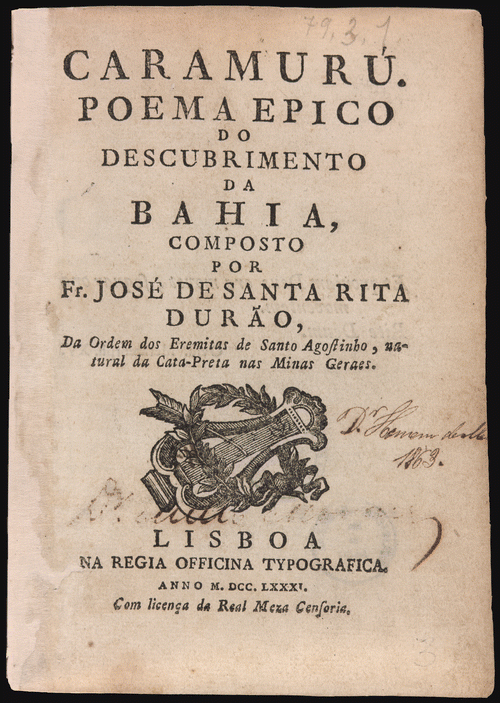
The name Caramuru became immortalized when José de Santa Rita Durão published an epic poem under his name in 1781.

And if Caramuru had never shipwrecked near Salvador, the entire history of Brazil could have been radically different.


Oba

In “The Fortuitous Meeting of Gerard van Oost and Oludara”, Oludara is called from his village to appear before the Oba of Ketu.

During Oludara’s lifetime, the supreme ruler of each Yoruba kingdom is known as an oba.  In most cases, they trace their ancestry back to the Orisha Oduduwa, creator of the earth, and thus they are considered sacred.  Subjects must prostrate themselves before an oba, after which they may sit or kneel on the ground in his presence.

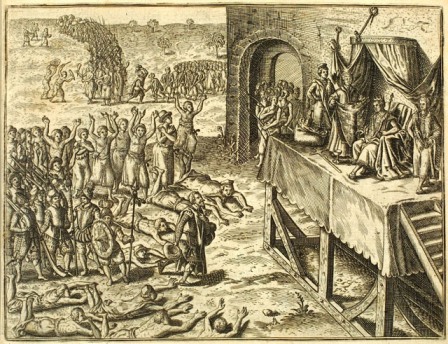
Subjects prostate themselves before an African oba as the Portuguese make their first contact – Late fifteenth century

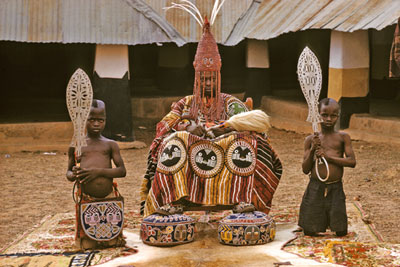
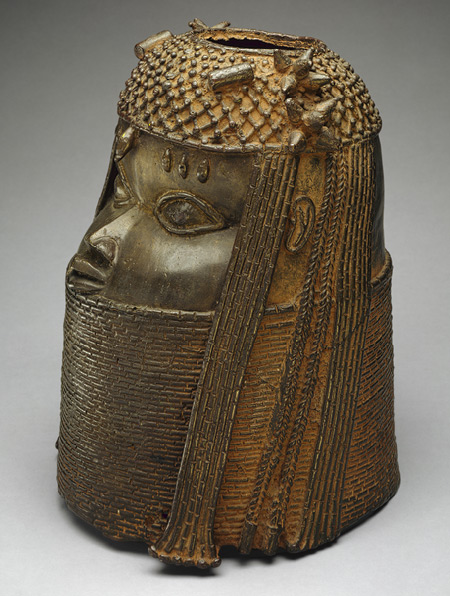
Only obas may wear the sacred Yoruba regalia: a conical bead crown, beaded slippers, and a beaded fly whisk.  The crowns are made from red coral beads, first introduced by the Portuguese.  Obas have several different crowns for different occasions, and each crown has its own history.  These crowns contain lines of beads which cover the oba’s face, in order to protect subjects from his divine gaze.

Oba Ademuwgun Adesida II in full regalia, 1959. Photo by by Eliot Elisofon

The oba is responsible for resolving problems external to the kingdom, and is the maximum authority on questions of justice.  He is aided by a council of elders, who will also choose his successor upon his death.  The village bale (chiefs), typically the eldest of the clan, handle local matters.

Due to the oba’s sacred nature, it is unthinkable to commit an act of violence against his person.  In some circumstances, however, the oba may have to perform violence against himself.  Once such circumstance is when the people rise up in protest against the oba’s rule, in which case the chiefs may demand the oba’s suicide.  Tradition also dictates that the oba can also never come face to face with the Oni Oja (the market chief), under penalty of death.  Thus, he can never leave the palace on market day.

The crowning of a new oba is a long, ceremonial process, requiring the future oba to make a pilgrimage through various shrines and holy places and participate in many rituals before returning to his city for coronation.  It often takes months to complete all the steps.  To give one example, the Ida Oranyan (Oranyan’s Sword, the Sword of Justice) must be brought from Ile-Ifé and placed in the the Oba of Oyo’s hand before he can come into power.

Once crowned, the king almost never ventures out during the daytime, except during a few very important festivals.  He may, however, leave his palace in cognito at night.

Brass oba head – Sixteenth century

The obas still exist throughout the Yoruba kingdoms today, although traditions have been modernized, particularly during the last hundred years.  For example, the custom of suicide has disappeared over time, but the Alaketu Adegbede was forced to take his own life as recently as 1858!  When he was called from his palace and saw the Oni Oja (perhaps by arrangement from his enemies), he and two of his wives had to drink poison.

Those who visit Africa today may have a chance to visit one of the Yoruban obas and learn more about their long traditions.  I hope to make my own visit soon!


Hans Staden

In “The Fortuitous Meeting of Gerard van Oost and Oludara”, Gerard cites Hans Staden as one of his influences in making the voyage to Brazil.  Truth be told, Hans Staden was one of my influences in creating the character of Gerard van Oost.

Hans Staden was a German mercenary from Homberg who made two voyages to Brazil in the middle of the sixteenth century.  On his first voyage, he participated in a naval raid in the Madeira Archipelago, fought French corsairs off the coast of Brazil, and was one of forty men who broke a siege of eight thousand natives around a small fort in Igaraçu.

Staden1_red

Battle against the French near Paraíba

But even all that was nothing unusual in his time–it was in fact his second trip which made him famous.   He was shipwrecked near São Vicente island, where he and other survivors were contracted by the Portuguese to man artillery at Bertioga Fort.  The Portuguese and their Tupiniquim allies were in constant conflict with the neighboring Tupinambá.

Staden3_red

Shipwreck near the island of São Vicente

While he was out hunting alone one day, Hans was captured by the Tupinambá.  They kept him prisoner for nine months.  During his time among them, he participated in battles, tried to convince French traders (allies of the Tupinambá) to rescue him, and did everything possible to escape, but all to nought.  He was also introduced to the original Brazilian barbeque: capturing and eating someone from a neighboring tribe.

Staden6_red

The Tupinambá roast an enemy while Staden protests

The Tupinambá intended to eat Staden as well, but with various excuses he managed to delay them until his rescue.  In the end, the French captain Guillaume Moner rescused him, tricking the natives into letting him go.

Staden9_red

Hans Staden returns home

Upon his return to Europe, Staden wrote of his travels in a book with the extremely descriptive title: “True Story and Description of a Land of Nude and Cruel Man-Eating Savages, Situated in the New World of America, Unknown before and after Jesus Christ in the Lands of Hessen until the Last Two Years.”  It is more commonly known as “Two Voyages to Brazil”.

This book became a European “bestseller”, so popular that fake versions were common (proving that pirate copies are nothing new).

Luís Alberto Pereria directed a fabulous movie in 1999 relating Hans Staden’s second voyage.  The movie is an impressively accurate recreation of the book.  To give one example, it is one of the only movies ever made which uses Old Tupi, the language spoken on most of the coast of Brazil when the Portuguese first arrived there in 1500.  What is impressive is that Old Tupi became extinct as a spoken language two hundred years ago!  The actors took lessons in Old Tupi from Brazilian historians, and had to memorize their lines one by one.  The movie is called Hans Staden, and I highly recommend it for anyone who can find a copy (which isn’t easy, even in Brazil).

(Images: From the original text by Hans Staden. Scribd version can be found here.)